Electrolysis Hair Removal in Berlin
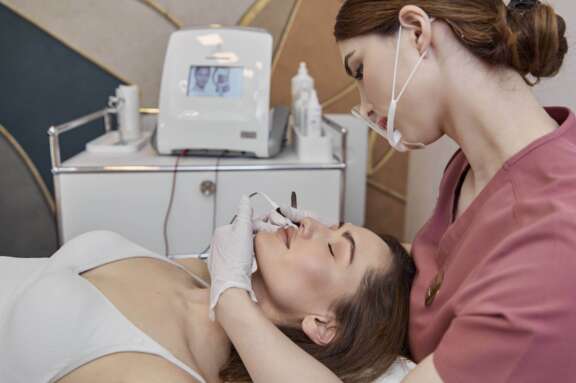
Apilus® Electrolysis
Electrolysis removes hair permanently. With the Apilus® xCell Pro each hair is treated individually: a fine probe follows the hair channel to the root, where the cell responsible for regrowth is disabled.
It is the method permitted to be described as permanent hair removal. Laser and IPL speak of permanent hair reduction. The difference is not wordplay. It is physics.
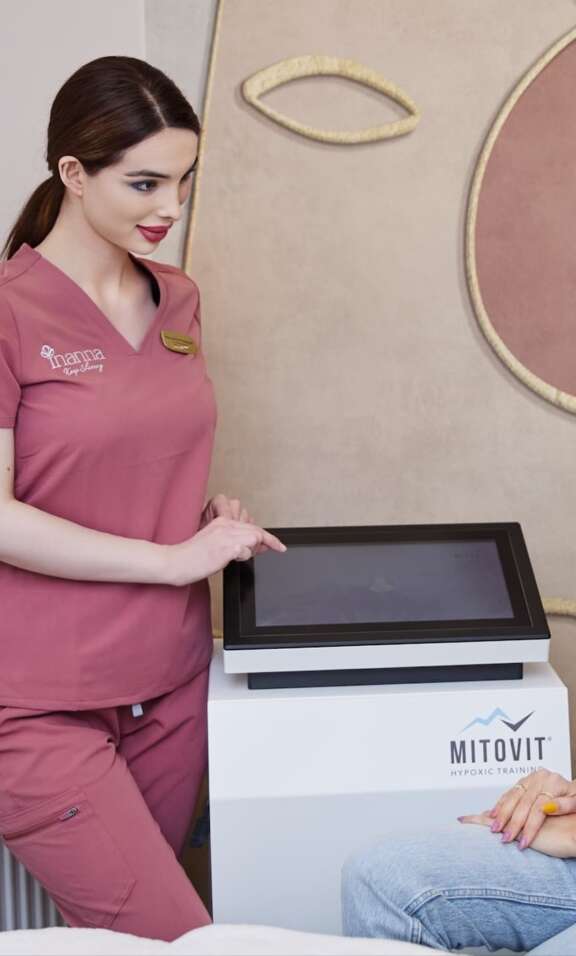
Zimmer CryoPro™ cold-air cooling accompanies every treatment without contact. The air passes first through a particulate filter and through UVC lamps.
Electrolysis with Apilus® xCell Pro
Why does laser not work on light or grey hair?
Because laser works through melanin. The light finds the pigment in the hair and converts it to heat. Hair without melanin, which is to say white, grey, blonde or red hair, gives it nothing to find. Electrolysis does not see colour. It works on the follicle itself, and it is therefore independent of both hair colour and skin tone.
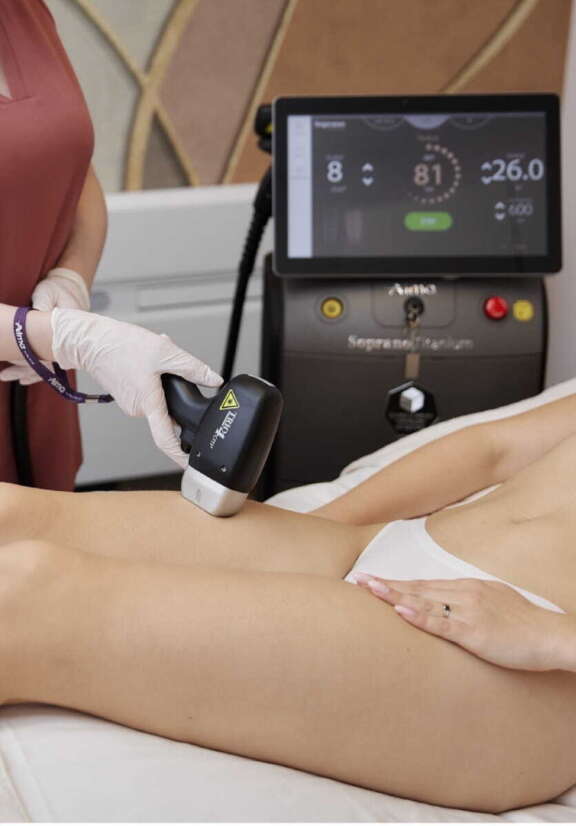
We will say the other half just as plainly: for large areas of dark hair, laser is faster, cheaper and more comfortable. A comparative study of the axilla (Görgü and colleagues, Dermatologic Surgery, 2000) found 74 percent clearance at six months with laser against 35 percent with electrolysis. If you are treating a large area of dark hair, Alma® laser hair removal is the better starting point. We say so even though it costs us a treatment.
Which areas do we treat?
All of them. On the face, the upper lip, chin, jawline, neck, cheeks and eyebrows. On the body, the underarms, arms, chest, abdomen, back, legs, hands and feet. The bikini line and the full intimate area. And the single hairs on moles, scars and tattoos that laser has to leave alone.
You book by active treatment time, not by zone. A single hair and a whole area are the same work, only of different lengths.
Can facial hair be removed permanently?
Yes. Electrolysis permanently removes hair on the upper lip, chin, jawline, neck and cheeks, one hair at a time. It also works where laser reaches its limit on the face. That means fine, light or grey hair, and hormonally driven growth that keeps returning. On the face, where the skin is at its most sensitive, the cold air accompanies every pass.
How long a facial session takes depends only on your hair. Isolated hairs on the upper lip or chin are often treated in an Apilus® × CryoPro™ Micro | 20. Denser growth can take up to sixty minutes. We look at it before your first appointment and tell you plainly where to begin.
What does electrolysis cost in Berlin?
The price follows the active treatment time. Twenty minutes is 100 €, eighty minutes 260 €, and the number in each treatment name is precisely that active time on the skin. What you see in the calendar is that time plus ten minutes for the first conversation.
How many sessions you need depends on the area, the hair density and the growth cycle. We estimate that before the first treatment rather than after it, and we would rather the estimate be honest than flattering.
What does a full course cost?
More than most people expect, and we would rather say so before than after.
We will not give you a total, because we do not know it. It depends on your hair density, your cycle, your hormonal situation. Any figure we named today would be a guess, and guessed figures are the reason courses get abandoned.
What we can say is that the alternative has a price too. Your waxing appointment, times the appointments in a year, times the years still ahead of you. Work it out once. We will not work it out for you, because the number is yours and not ours. The difference is not the size of it. The difference is that one of the two calculations ends.
Does health insurance cover the cost?
No. Inanna is a private house, and electrolysis here is a private service. That holds even where a physician recommends it or a surgery requires it. You receive an invoice from us that you can submit to your insurer. Whether it reimburses is the insurer's decision, not ours.
Does electrolysis hurt?
You will feel it. Every insertion is a needle in a follicle, and a session consists of many of them. We would rather describe what we do about that than make a promise the method cannot keep.
Comfort here is not an amenity. It is the condition on which the method works at all. A study of 46 people (Mankowski and colleagues, Archives of Sexual Behavior, 2024) found that despite an average of fourteen sessions the respondents reached only about two thirds of the expected clearance, and rated pain management at 57 out of 100. A course that is not finished produces no permanent result. That is how this method fails, when it fails.
So we work in two layers. You bring the first, and we recommend it plainly: a topical anaesthetic, applied by you at home roughly two hours before the appointment. We neither supply it nor apply it. Obtain it through your pharmacy or physician, and clarify its use there.
The second layer is ours: the Zimmer CryoPro™ cold-air unit, a standalone device that accompanies every session without contact and throughout. We measure the skin temperature and work in a range around 17 degrees. That is our own observation from practice, not a figure from the literature, and we present it as what it is.
How many sessions are needed, and why does it take so long?
Because only hairs in the active growth phase can be reliably reached, and on the body that is only about 15 to 20 percent of them at any moment. The rest are resting. An area must therefore be treated repeatedly, as dormant follicles enter the growth phase in turn.
When hair returns between sessions, that is not a setback. It is the cycle: follicles that were asleep last time have woken. Electrolysis is a sequence of calm visits across months, not a single treatment, and the intervals lengthen over time. You receive clear orientation from the beginning, because this is precisely the point at which most courses are abandoned.
How sterile is the work?
Every treatment opens the skin at many hundreds of fine points in a single session. We work with sterile single-use probes, new for each guest, and with insulated probes that concentrate the energy at the base of the follicle and spare the upper follicle wall. For antisepsis we use octenidine, which remains effective in the presence of protein, and that is not a given where pinpoint bleeding occurs.
The cold air that meets that opened skin passes first through a particulate filter and through UVC lamps. That is why we chose this device and not a cheaper one.
What should you do before and after?
The hair must be visible, at least three millimetres, because the probe follows the shaft into the follicle. Do not shave, wax or pluck. No caffeine and no sun on the day.
Afterwards the skin may be briefly reddened and usually settles quickly. For forty-eight hours: no heat, no sauna, no exercise, no makeup on the treated area. The follicles are open. Do not scratch, do not lift a scab, and protect the area from the sun.
Who is electrolysis for?
For people whose laser treatment did not work, because the hair was too light, too grey or too fine. This is the largest group, and it almost always arrives disappointed.
For people whose hair growth is hormonally driven, as in PCOS. Here laser meets a second limit: it clears the hair that is there, but new follicles continue to be activated for as long as the hormonal cause persists. Electrolysis treats each follicle individually and permanently, including those that appear later.
For people preparing for surgery who need complete, documented clearance. For people who want to be rid of a single hair that has been keeping them company for years. We do not ask why. We ask what you want to achieve.
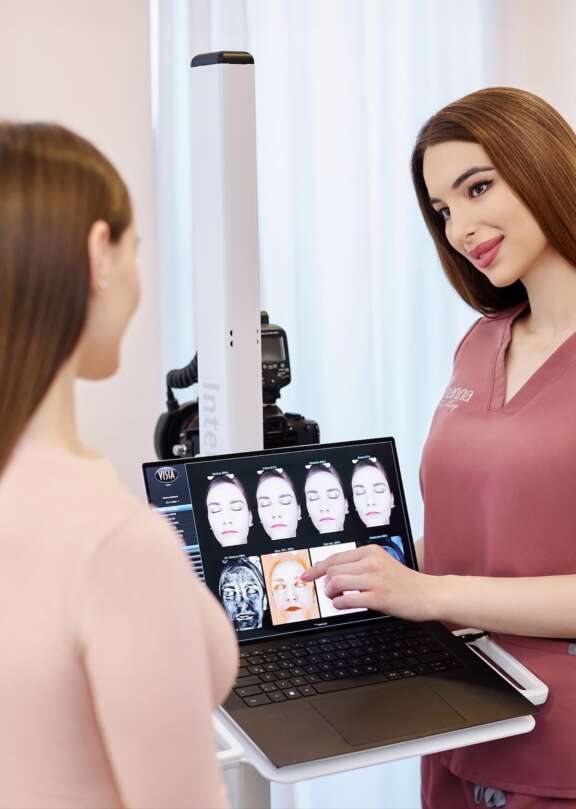
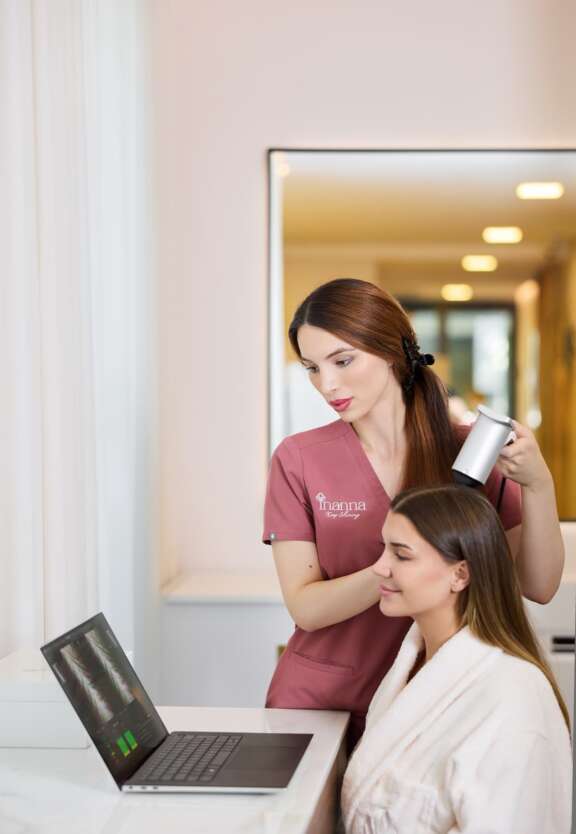
Before every visit we take ten minutes. Not only before the first. We look at the skin as it is that day, you ask your questions, and the required consent is signed. If you are unsure which treatment suits you, we begin with an Inanna Consult®. For questions, reach us at any time.
How did the method develop?
Through three modalities. Michel's galvanic current works chemically. Thermolysis followed, producing heat through high frequency and working considerably faster. In 1945 Henri St. Pierre and Arthur Hinkel combined the two into the Blend; the patent issued in 1948. Their 1968 text, Electrolysis, Thermolysis and the Blend, remains the profession's reference to this day.
In Germany, electroepilation is not reserved to physicians. It requires the NiSV qualification for high-frequency devices in cosmetics, which we hold.
What do we work with?
The instrument comes from Québec, Canada. There, Dectro International has developed devices for permanent hair removal since 1978 and introduced the first computer-controlled epilator, the Apilus, in 1989. The Apilus® xCell Pro works at a signature frequency of 27.12 MHz and with pulses of a few thousandths of a second. The higher frequency concentrates the energy more closely at the probe tip and disperses less heat into the surrounding tissue than the older generation of devices.
Why cold air, and why filtered?
Because cooling here is not an accessory but part of every session. We work with cold air from Zimmer, a German maker of cooling technology for aesthetic use. The system directs filtered cold air to the treated area without contact, before, during and after each pass, in a steady, adjustable stream. Because it works without contact, it needs no gel, spray or single-use material, and it never touches the skin.
We tested the device for a month in December 2025 before committing to it. Since then we have observed in our practice that the skin appears calmer on the day after treatment. That is our observation. We do not present it as a study.
At Inanna, the device is never in the foreground. The Meisterinnen des Hauses work hair by hair, in a rhythm set by skin and hair growth. Technology amplifies what the hand begins. This stance, accuracy before intensity, is part of the Inanna Method®.
The house behind the care
Electrolysis in this house means time, not speed. Each hair is treated on its own, and the device stays behind what the hand begins, in keeping with the Inanna Method®. Ten minutes belong to every visit here, not only the first: the Inanna Consult®, in which skin and hair are read on the day, before anything begins.
This care rests in practiced hands. The Meisterinnen des Hauses guide every session with restraint. One senior Meisterin is responsible for the professional work of the house; another trained at the Institut Takumi Finch in Paris, in the tradition of Kobido®. They work by one principle: first listen to what the skin shows, then do the lesser thing.
Electrolysis has been in use since 1875. In that year, the ophthalmologist Charles E. Michel in St. Louis described the first documented application in the Clinical Record, originally for ingrown eyelashes. Its underlying principle, treating the single follicle through a fine probe, has remained the same to this day. In 1945 Henri St. Pierre and Arthur Hinkel combined galvanic current and thermolysis into the Blend; their 1968 text remains the profession's reference.
Our instrument comes from Québec: Dectro International has developed devices for permanent hair removal since 1978, and the Apilus® xCell Pro works at a signature frequency of 27.12 MHz that concentrates the energy closely at the probe tip. Our cold air comes from Zimmer in Neu-Ulm: the Zimmer CryoPro™ passes the air through a particulate filter and four ozone-free UVC lamps before it reaches the skin without contact. We tested the device for a month in December 2025 before committing to it, and since then we have observed in our practice that the skin appears calmer on the day after treatment. That is our observation, not a study.
This posture is noticed. Inanna was named Best Day Spa Germany 2024, 2025 and 2026 by the World Spa Awards, is the only CIDESCO-certified house in Berlin, and was portrayed in Vogue Italia in 2025.
Electrolysis here is an aesthetic, non-medical treatment. Where hair growth needs medical assessment, for instance when it appears suddenly or changes quickly, the medical assessment comes before the treatment; the house makes no medical assessment and accompanies through care.
Inanna is a house for aesthetic wellness and replaces no medical diagnosis or treatment. Your path begins with the Inanna Consult®, the calm reading of your skin. Contact and directions are here.
Treatments