Japanese Facial Massage & Kobido® in Berlin-Mitte

Kobido® Facial Massage
The Kobido® facial massage is the old Japanese art of facial massage, worked with the hands alone. No devices, no needles, no downtime. Only modeling strokes, acupressure, and a quiet rhythm that follows the face.
Before every visit, we take ten minutes to read your skin on that particular day. How the session is led follows what it shows. In Berlin-Mitte, in a private house.
Kobido, the Japanese facial massage
A visit does not begin with the hands. Ten minutes go to reading the skin before every visit, on the day itself. Not only the first time. Every time, because skin does not hold still between appointments. Then the Meisterin des Hauses, the master of the house, holds her hands beneath the face cradle. You take six to eight conscious breaths. This is the Inanna Aromatherapy®, which opens every Journey in the house. No open flame, no smoke. Only then does the work begin.
Kobido® Takumi Finch™ is refined Japanese facial massage. Rhythmic movement, varying tempo, controlled pressure. Practised with restraint and sensitivity. It can be booked on its own. It is also the manual component of five Inanna Signature Journeys. These run from the Inanna Heritage® to the Inanna Couture®. The rhythm that carries this work is set out in our philosophy.
What is a Kobido facial massage?
A Kobido facial massage is worked by hand alone. It joins modelling and lifting strokes with light, rhythmic percussion. To these it adds precise acupressure along the face and neck, and lymphatic strokes. The work covers face, neck, décolleté and scalp. Hands only, with Japanese camellia oil. The name denotes a lineage and a house, not a technique in general.
What is a Japanese facial massage?
In Europe, Japanese facial massage usually means Kobido. The term is used broadly, for very different kinds of work. Kobido is a lineage name rather than a category. The house works this one transmission, learned at the school that holds it. What is worked here is the sequence that lineage teaches. Sixty minutes, by hand. Where the lineage comes from, and what is documented about it, is set out in the section on the house.
What happens during a Kobido facial massage?
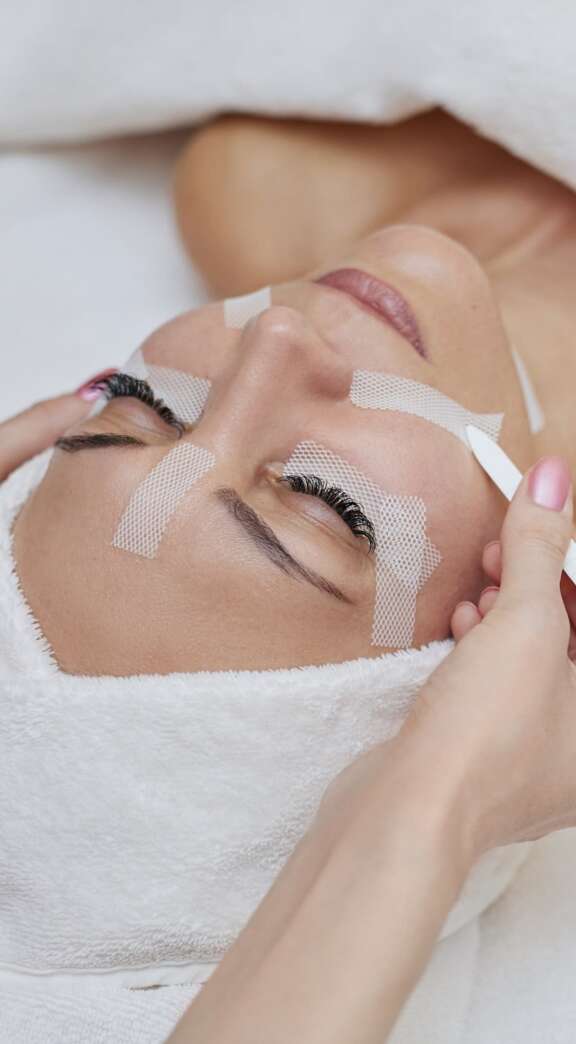
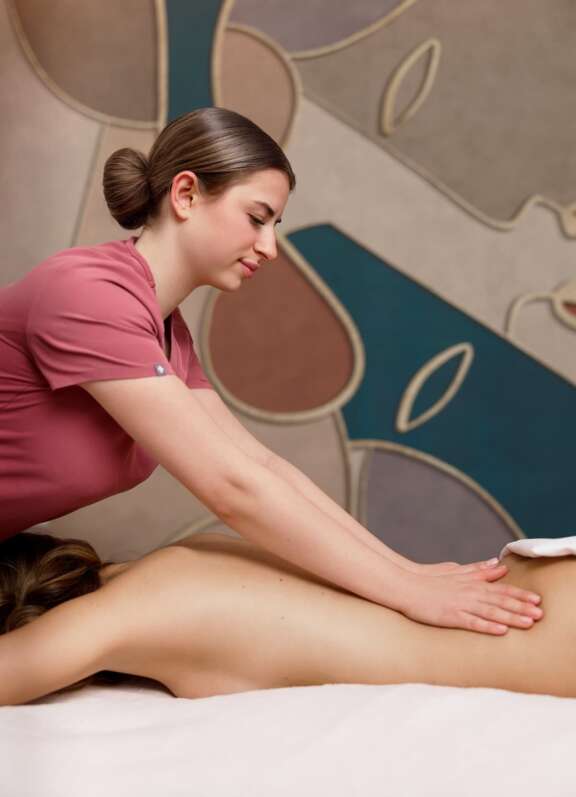
After the conversation the skin is cleansed and prepared with a few drops of camellia oil. The work begins at the décolleté and moves over neck and nape. It then goes to the face. Light percussion and quiet strokes alternate at a continually changing rhythm. Many guests fall asleep. At the end there is a tone. The Meisterin des Hauses strikes a bowl of fused quartz once, and the sound carries for about two minutes. A guest who has fallen asleep wakes to it, without being touched and without being spoken to. There is time afterwards to rise unhurried. The skin often shows a passing flush that settles within half an hour. You leave as you came, only slower.
Where in Berlin-Mitte does the Kobido facial massage take place?
At Charlottenstrasse 19, a few steps from the Gendarmenmarkt. The house sits behind an unremarkable door and gives nothing away from the street. Appointments are placed so that you meet no one at reception. There is no pool and no sauna. That is Inanna Privé®, and it is an arrangement rather than a promise. Booking is online or in conversation.
Who is Kobido for, and who is it not for?
Kobido is strong, living work. With active acne, inflamed skin or a rosacea flare it is postponed. The same holds for a skin infection and for open lesions. After facial surgery we wait. After botulinum toxin or filler we wait as well, and we agree the timing with you. For very reactive skin we choose a calmer form in conversation. For sensitive and redness-prone skin the house holds a path of its own. Sometimes less is the right answer on the day. Where medical assessment is sensible we say so, and we do not treat.
How does Kobido differ from other facial massage?
Most facial massage is relaxation, with oil and even pressure. Kobido is a choreography. Tempo and pressure change continuously, and the techniques follow a set order. Alongside it the house keeps a second hand, Sculptural Face Lifting™. That one is worked more slowly and reaches deeper, at muscular structure, tension and asymmetry. On request, after explanation and explicit consent, it extends to the inner structures of the face. Both last sixty minutes. In five Inanna Signature Journeys one of the two is the manual component. The choice is made in conversation, not from a list.
How does Kobido differ from lymphatic drainage?
Both are worked by hand, and there the resemblance ends. Kobido is modelling, rhythmic work at changing pressure. The manual lymphatic drainage after Dr. Vodder® is another matter. It is a method in its own right, far gentler and protocol-led. It follows the course of the lymphatic vessels. The house offers both and does not choose for you. If you feel heaviness and swelling, lymphatic drainage is the answer. If you are looking for tone in the face, this is.
How do I know a Kobido practitioner is trained?
Ask three things, and any honest provider will answer them. Which school. At what level. In which year. Kobido names a lineage rather than a category, so a school can always be named. The Institut Takumi Finch keeps a public register of its specialists, and this house is on it. The Meisterin who performs this work here holds the Spécialiste level. Certificates carry numbers, and a number can be checked.
What is established, and what is not?
Small controlled studies exist on facial massage in general. They show a temporary rise in skin blood flow. And plausible effects on relaxation and the autonomic nervous system. Durable firming or the remodelling of collagen is not established by them. On Kobido itself there is no randomised controlled trial. There is one small uncontrolled observational series. So the house says what this work does. And promises nothing it cannot carry.
The house behind the care
Facial work here does not begin with touch but with listening. We ask how the day has been and what the skin will accept today. Only then is it settled how the session will be led. Ten minutes of conversation precede every visit, not only the first. The Inanna Consult® is the quiet first step for anyone who does not yet know us.
This work is carried by the Meisterinnen des Hauses, whose craft stands in documented lineages. Each learned her line at its source. The hand leads, the technology follows.
The house uses the name Kobido® with the express consent of the lineage holder. Dr. Shogo Mochizuki granted it in correspondence during 2025. By his own public account Kobido denotes a lineage and a company. Not Japanese facial massage in general. The house is trained at the Institut Takumi Finch, founded by Sandrine Takumi Finch. She signs her certificates as Apprentie des Maîtres Fondateurs, apprentice of the founding masters. Not as a lineage holder. The institute is registered in France under SIREN 832 632 269. As a training provider it is registered with the Préfecture de la Gironde under number 75331152133.
It describes its own method in its own words. It calls them techniques inspired by and derived from ancestral Japanese arts. Rooted in the legacies of Kobido, Kyo Ku Te and Shiatsu. Reinterpreted with a scientific approach. That is an unusually precise self-description. The house repeats it rather than telling a founding legend. The technique 曲手, kyokute, is documented. The Yoshida-ryū textbook of the Tokyo Iryo Fukushi Senmon Gakko lists it among the basic techniques. The professional journal Ido no Nippon shows it in a 2018 demonstration. In the Japanese literature it is a technique of full-body anma. As work on the face it is a European rereading.
Havanur Erkilic, Meisterin des Hauses, is Kobido Spécialiste of the Institut Takumi Finch. She was taught by Sandrine Takumi Finch and Monika Wieczorek, from 11 to 16 April 2026. The house is listed on the institute’s own specialist register.
The oil has an origin too. The Yōrō Code enters anma into the court record in 718. Two years later the Nihon Shoki, the chronicle of 720, records the camellia. The chronicle knows it as a tree whose wood was made into weapons. Not yet an oil, and not yet care. As a material for skin and hair, camellia oil is documented from the Edo period. Cold-pressed from the seeds. Geisha and maiko wore it on hair and skin. It belonged to the rituals of nobles and tea masters. The harvesters of Ōshima Island were known for their hair and their skin. In that same period anma became a recognised occupation. The hands and the oil come from one age. The house does not claim that they travelled together. Classical anma is worked through clothing and with no oil at all. So the house says only what every stroke needs. A medium that neither drags nor slips. That is what this oil is for. In the session it joins in its present-day form. As Gold Camellia Beauty Oil by Tatcha®, with 23-carat gold leaf. A quiet close. The oils of the Inanna Aromatherapy® come from Original Swiss Aromatics. Dr. Kurt Schnaubelt founded that house in 1983. The largest share is wild-harvested lavender from the Haute-Provence. Cut by hand with a sickle.
The fused quartz bowl that closes the session is younger than it looks. Bowls like this are a late twentieth century American invention. They come from the crucible technology of semiconductor manufacture. Quartz is melted in that process to grow silicon. Each bowl carries a serial number, a stated note and a stated frequency. The Meisterinnen des Hauses chose ours themselves, in these rooms, from several instruments.
The house is named by others. World Spa Awards, Best Day Spa Germany 2024 and 2025. The only CIDESCO-certified house in Berlin, portrayed in Vogue Italia in 2025.
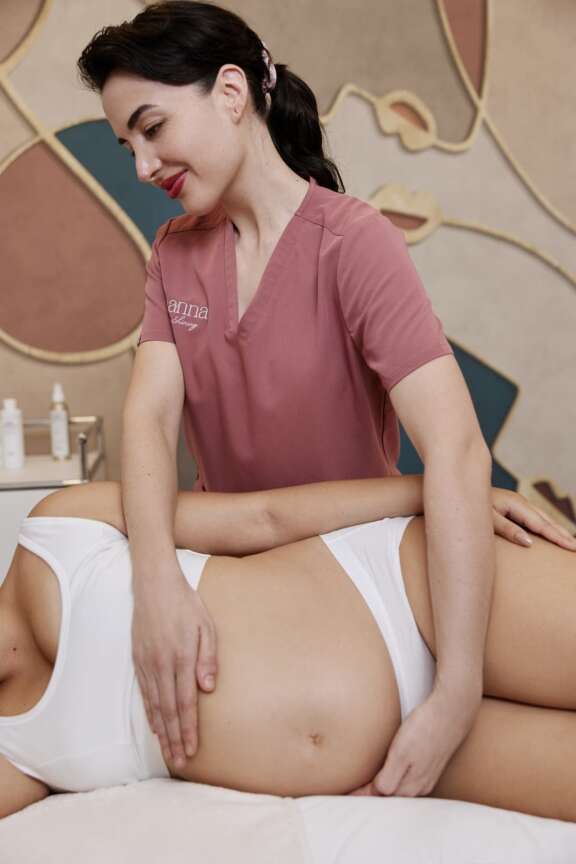
Care includes the boundary. We do not work where someone else should be asked first. With acute inflammation, infection or open lesions we ask you to seek medical advice first. The same applies after a procedure on the face. In pregnancy and the time after it, this work has its own place, in the MamiSpa®.
Inanna is a house for non-medical, device-assisted and manual care. We make no diagnoses and treat no conditions. At the end stands not the method but the person. Accompanied calmly and without haste. The quiet first step is the Inanna Consult®, and whenever you wish, write to us here.
Treatments