Lymphatic Drainage Massage in Berlin-Mitte
Dr. Vodder® Lymph Drainage
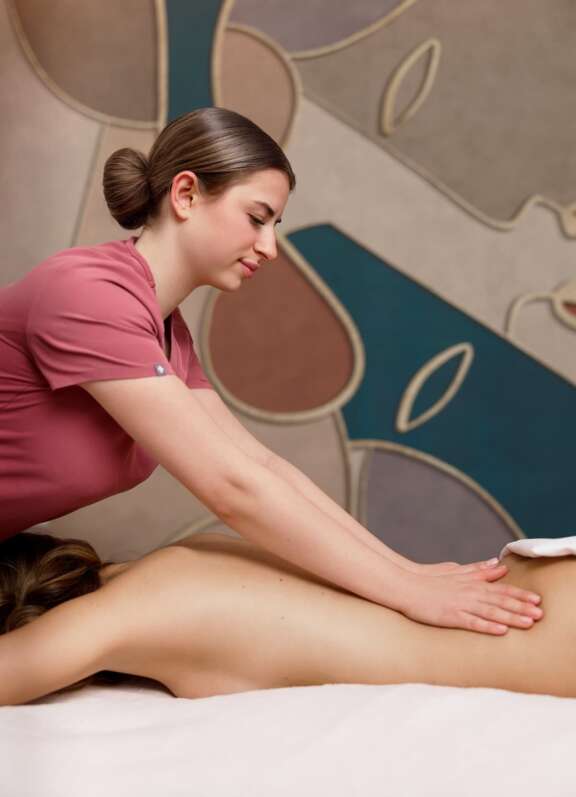
Manual lymph drainage by Dr. Vodder® is one of the oldest manual techniques we know. Some people call it lymphatic massage. It works with the hands alone, in slow, circling movements. The rhythm comes from the body, not from the clock.
Many guests are surprised by how quiet the work is. That quietness is the point. The fine lymphatic vessels sit just beneath the skin. They respond only to a soft, stretching touch. The pressure is about the weight of a coin. Firm pressure passes them by.
The work is done on dry skin, without oil. That is not a preference. It is the method itself. The hand takes the skin with it and opens the fine vessels underneath. Oil would let the hand slide over the skin instead, and those vessels would stay closed. The method allows one exception. It applies where the skin will not move, over a scar or where the skin is very dry.
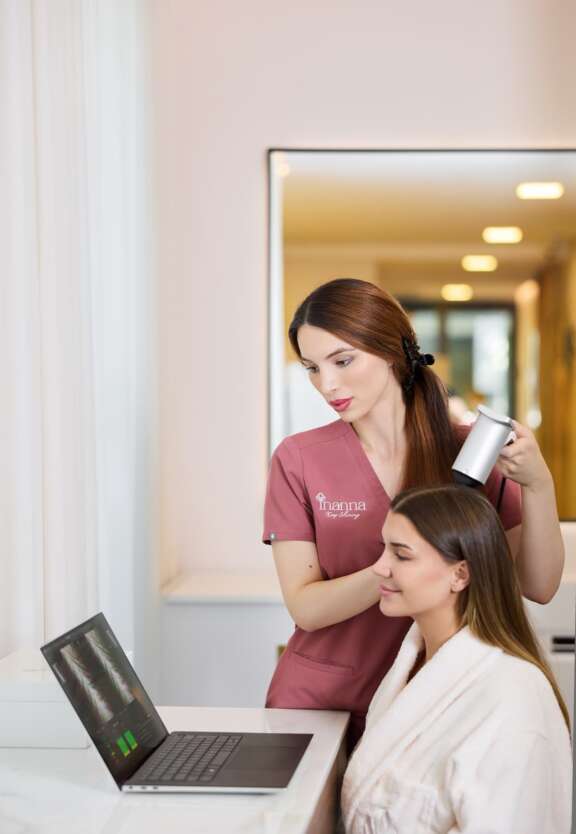
Your first visit opens with a quiet conversation of about ten minutes. The Meisterin des Hauses, the master of the house, reads the body on the day. She shapes the session around it. From the second visit the session begins directly. The room is quiet. Appointments are spaced so that you meet no one. This work is for women. Nothing is rushed.
As much as the body needs
Lymph drainage by Dr. Vodder® cannot be carried over the whole body in one session. It is always work in stages. It follows the lymphatic pathways in their own direction and at their own pace. From the centre of the body outward, region by region. So each visit gives its full attention to one clearly defined area. Thoroughly rather than quickly. At Inanna it comes in two lengths. Dr. Vodder® Focus gives 30 minutes to one area. Dr. Vodder® Continuum gives 60 minutes to two adjoining ones. The face counts as one of those areas.
Every session opens with Inanna Aromatherapy®. The hands of the Meisterin des Hauses rest ten to fifteen centimetres beneath the face cradle. Six to eight conscious breaths, with no open flame. The work then begins at the neck and the terminus, where the lymph empties into the veins. That holds even when the face is the region of the day.
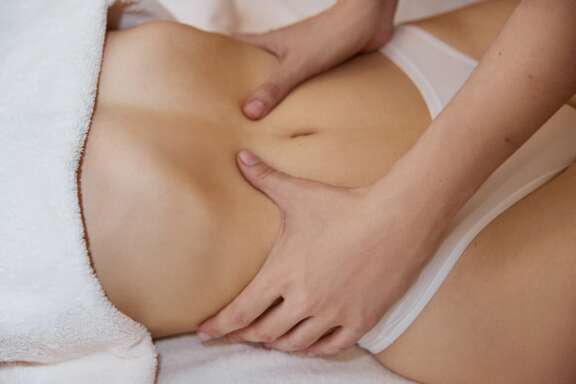
For body work you have two options. You are undressed beneath the sheet, or you wear the house slip. Either is fine, and the choice is yours. The reason is anatomical. The lymphatic pathways of the legs and lower abdomen run toward the groin. A high-cut everyday brief sits exactly on that crease. We do not use disposable slips. They are thrown away after twenty minutes, and you can feel that. The house slip is sewn with as little seaming as possible, so no seam lies between hand and skin. If you take it, it is yours.
At the end there is a tone. The Meisterin des Hauses strikes a bowl of fused quartz once, and the sound carries for about two minutes. A guest who has fallen asleep wakes to it, without being touched and without being spoken to. Then tea, and time.
Does lymphatic drainage massage actually work?
It depends what you are asking it to do. The technique is safe and well tolerated, and that much is well established. What most guests notice is a real but temporary lightness, lasting hours to a day or two. What it does not do is remove toxins, reduce fat, or change body shape. Several high-quality studies found no significant effect on swelling. We would rather tell you that than sell you something else.
What does a facial lymphatic drainage session do?
The face counts as one area, so it is a Dr. Vodder® Focus. The work still opens at the neck and the terminus before anything touches the face. That is the order the method requires. Guests describe the face as feeling lighter and looking less puffy. That usually arrives within hours and holds for a day or two. It is not a lift and it is not a facial. If you want the skin itself worked on, that is our facial treatments.
Who is qualified to give a lymphatic drainage massage?
We can answer for this house rather than for the profession. The Meisterin des Hauses who leads this work trained at the Dr. Vodder Academy in Walchsee, Austria. That is where the method itself is taught. Her certificate covers whole-body application within health prevention, on healthy people. What it does not cover is treatment under medical care. Anything prescribed, and anything a doctor is supervising after surgery, sits outside it. Those we refer out, and we say so plainly.
Do I need a referral, and can I pay privately?
No referral, no prescription, no insurance approval, and no waiting list. Dr. Vodder® Focus is 120 €, and Dr. Vodder® Continuum is 180 €. That is the full private fee. Where a medical finding or a procedure is involved, we work only once your doctor has cleared you. That condition is part of the care rather than an obstacle.
When is lymphatic drainage not suitable?
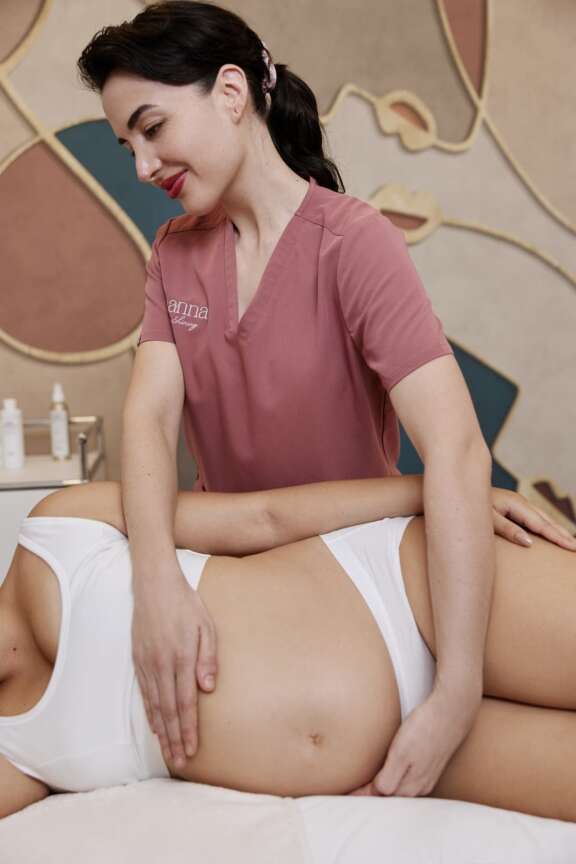
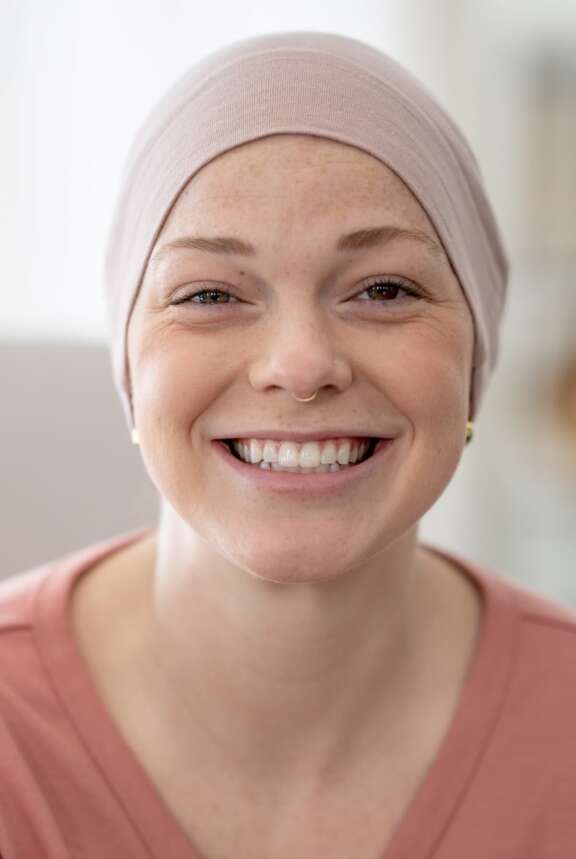
There are situations where we do not work, and we ask about them in conversation. Not during an acute infection. Not with an acute thrombosis or vein inflammation. Not with an untreated cancer. After a treated cancer, only with your doctor clearing it. OncoSpa® is the path made for that, and the first step is always a conversation. The same applies to heart or kidney conditions. Where lymphoedema or lipoedema has been diagnosed, the treatment belongs with a doctor. We work there only with medical clearance, and even then not on the cause. We do not offer this work in pregnancy. After birth, MamiSpa® is the path made for that. And where anything remains unclear, we do not work.
How light is the pressure?
About the weight of a coin. The initial lymphatic vessels sit immediately under the skin. Heavier pressure would close them rather than open them. This is also the honest answer to the device question. A hand takes the skin with it and moves it; a device slides across the surface. That difference is the whole mechanism, which is why this work is done by hand and without oil.
How many sessions, and how often?
Because the work is staged by region, a sequence of visits follows almost by itself. One region, then the next. A single session still stands on its own and is worth having on its own. Guests who stay with it for a while usually come every one to two weeks, then about once a month. That is a rhythm rather than a course, and we do not prescribe it. A frequency that follows from a medical assessment is not ours to set. What suits you becomes clear in conversation.
The house behind the care
People rarely come for the technique. They come because the legs feel heavy. Because the face looks different in the morning than at night. Or because they once had something vigorous that felt wrong. We listen first. If you are not sure whether this work suits you, begin with the Inanna Consult®. Ten minutes, before anything starts.
The work is led by the Meisterinnen des Hauses. The title is not ornament here. It names a craftswoman who has learned a tradition and practises it rather than varying it. At Inanna the hand leads and the technology follows. This work needs none.
Emil Vodder was born in Copenhagen on 20 February 1896 and died in February 1986. His doctorate was in art history, conferred in 1928 by the University of Brussels. He had been forced to break off medical studies in his eighth semester after malaria. He was never readmitted. That he was a physician appears in many accounts and is not true. Estrid Vodder was a naturopath and a co-developer, not an assistant.
Around 1929 the two moved to the French Riviera and ran a small institute in Cannes. Many of their guests came from England, many with stubborn colds. Nearly all carried swollen lymph nodes at the neck. The lymphatic system was considered untouchable then. Systematic study began in 1932. It was guided by the copper engravings of the anatomist Sappey, Paris 1885. In 1936 Emil Vodder presented the method publicly in Paris, under the name it still carries.
What happens can be described precisely. The initial lymphatic vessels sit just beneath the skin. Fine anchoring filaments hold them open. The stroke displaces the skin, draws on those filaments and opens the inlets. From there lymph passes through precollectors into collectors. These are segmented into lymphangions that contract rhythmically. The path ends at the terminus, at the venous angles. The pressure is around 30 torr, roughly four kilopascals. It alternates down to almost nothing. Four basic strokes carry the method: circling, pump, scoop and rotary. Between them there is always a brief rest.
The work was carried forward by Dr. Johannes Asdonk. He took it up in the early 1960s and produced the first indication list. In 1967 Vodder, Asdonk and Günther Wittlinger founded the professional association. Günther and Hildegard Wittlinger founded the school at Walchsee in Tyrol. Today it is the Dr. Vodder Academy at Alleestraße 30, A-6344 Walchsee. The Meisterin des Hauses who leads this work at Inanna trained at Walchsee. At the source of the method. What reaches you in the session is not an approximation of the technique but the technique itself.
One thing we say openly, because it is rarely said. The evidence is mixed. Several high-quality studies found no significant effect on swelling. That is one reason we speak carefully here. What is well established is that the work is safe and well tolerated. What we observe is a feeling of lightness and calm. It holds for hours to a day or two. We promise nothing beyond that.
Three things in the room have a provenance of their own. Inanna Aromatherapy® is the house's own blend and not a product for sale. Three oils from Original Swiss Aromatics, the company Dr. Kurt Schnaubelt founded in California in 1983. He is a chemist with a doctorate from the Technical University of Munich. Sixty percent fine lavender, gathered wild in Haute-Provence. Above eight hundred metres, often over a thousand. Cut by hand with a sickle. That harvest carries the mention SIMPLES, a mark of the Syndicat SIMPLES founded in 1982. It is reviewed each year by another producer. Fine lavender yields little: lavandin gives nearly three times as much oil. With orange, and ten percent ho wood, which stands in for the rosewood that CITES has listed since 2010.
The fused quartz bowl that closes the session is younger than it looks. Bowls like this are a late twentieth century American invention. They come from the crucible technology of semiconductor manufacture, where quartz is melted to grow silicon. Each bowl carries a serial number, a stated note and a stated frequency. And the house slip is one hundred percent TENCEL™ Lyocell. The fibre carries the EU Ecolabel under licence AT/016/001. The finished garment holds OEKO-TEX® STANDARD 100.
The World Spa Awards named Inanna Wellness the best day spa in Germany in 2024 and 2025. We are the only CIDESCO-certified house in Berlin. In 2025 Vogue Italia portrayed the house. We mention it because it answers a question anyone is right to ask.
What this work is not belongs here too. It does not replace medical or therapeutic care. We work only with healthy people. We make no diagnoses. Where a prescription exists, a physiotherapy practice is the right place. The same holds where a medical condition is involved. With persistent, one-sided or unexplained swelling, please have that assessed by a doctor first.
Inanna Wellness is a private house for skin and hair in Berlin-Mitte. We do not work therapeutically. How we work, and why, is set out in our Philosophy. If you are unsure, begin with the Inanna Consult®, or write to us. We listen before we advise.
Treatments