IHHT Altitude Training in Berlin-Mitte
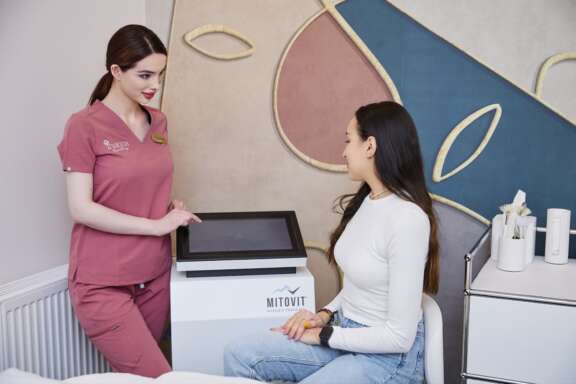
Mitovit® IHHT
Nothing is applied and nothing is removed. IHHT works where the cell makes its energy, in the mitochondria.
Intermittent Hypoxia-Hyperoxia Training, or IHHT, is a calm breathing practice you follow lying down. Through a mask, you breathe air whose oxygen content alternates between reduced and enriched, attuned to your body on the day of your visit. A simulated altitude stimulus, entirely at rest, with no mountain and no exertion.
At Inanna that is one of three layers in the Inanna Method®. At the surface, the work on skin and scalp; in the interior, nutrition with the Swiss micronutrient system HCK®.
This practice is heavily advertised. This page also sets out what it cannot do, and who it is not suitable for.
IHHT in Berlin-Mitte
A Mitovit® IHHT session runs fifty minutes of treatment time. You lie down, you breathe, and there is nothing more to do. Through a mask the air alternates between a reduced and an enriched share of oxygen, led by what your body shows on the day. The phases change in short stretches of a few minutes. Before the first cycle we read your baseline, the saturation and the heart-rate variability. At the end the mask comes off and you sit a moment before standing.
What happens in a session, and how does it feel?
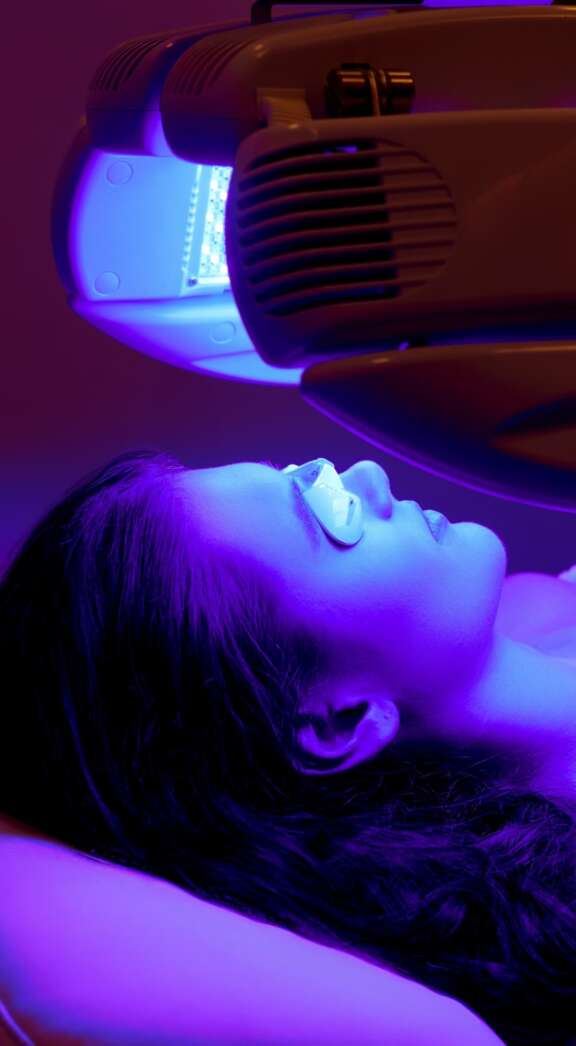
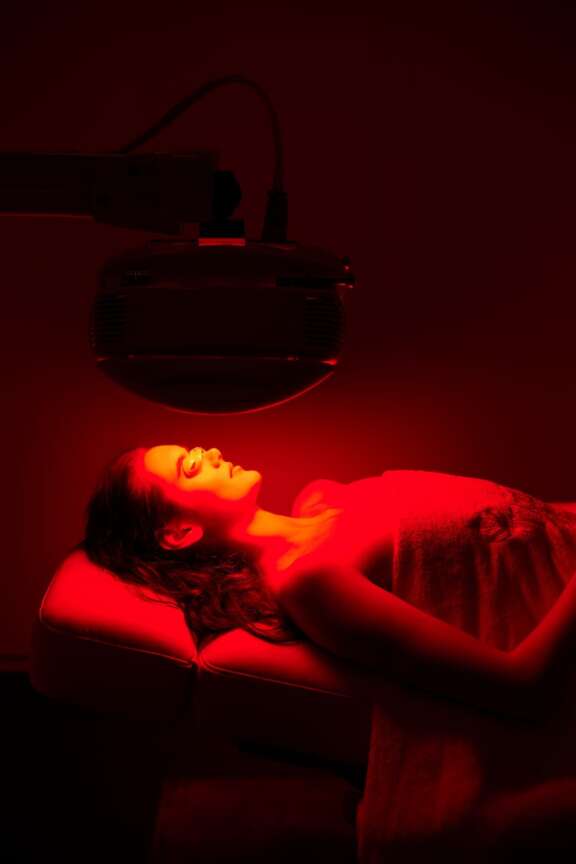
The mask is placed, the light is low. Over fifty minutes the breathing phases alternate. There is little to feel: a mild warmth, occasionally a lightness in the head during the reduced phase.
The bed is warmed if you would like it. Whether you undress is your decision, and the linen is made for it.
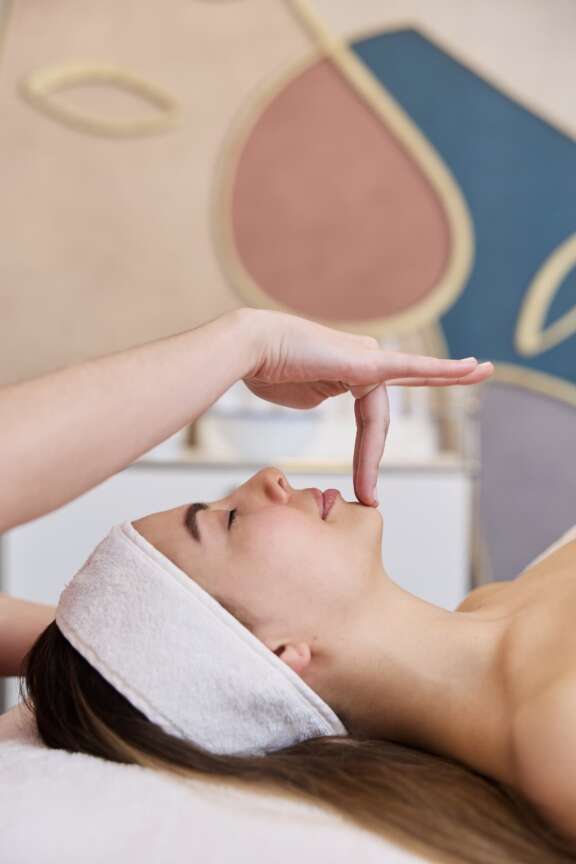
Before the mask, the Meisterin des Hauses holds her hands beneath your face. You take six to eight conscious breaths. That is Inanna Aromatherapy®, which opens every treatment in the house, with no open flame. At the close a bowl of fused quartz is struck once. A work of art runs on the screen, and the music in the room is the house's own. Appointments are placed so that you meet no one. That is Inanna Privé®: no pool, no sauna, no door that opens.
You can watch your own oxygen saturation on the screen. Some find that reassuring and some find it unsettling, and either is fine. After a first session some guests are tired rather than energized. That is a normal response to a training stimulus, and we say so beforehand. The mask can be lifted at any moment, and a session that ends early is a valid outcome here. Eat lightly beforehand and arrive rested where you can. Afterward keep your fluids steady and rest if the body asks for it.
Who is IHHT not suitable for?
Not during pregnancy, not during an acute infection or fever, and not if you feel unwell on the day of your visit.
Before a first session we ask for medical clearance. That applies with unstable or uncontrolled cardiovascular disease, after a cardiac or cerebrovascular event, with significant chronic respiratory disease, and with a seizure disorder. Where a physician is caring for you for a condition the training might touch, their judgment governs and we follow it. Before a first visit we also take an extended questionnaire: cardiovascular and respiratory history, altitude experience, your condition on the day, and what you are hoping for.
What can this device do that a simpler one cannot?
The Mitovit® reads two pulse oximeters at once and cross-compares them. If the two readings diverge, or one fails, the system switches on its own to room air or to the enriched phase.
A safety valve releases room air in the event of a power failure. The oxygen is produced inside the device, so no cylinders stand in the room, and the breathing air is re-humidified. The second reason this device is the one we hold is heart-rate variability: the Mitovit® displays parasympathetic activity during the session, so the recovery phase follows your own nervous system rather than a preset clock. A recovery phase set too rich prolongs the descent and shortens the useful work, and sustained enrichment carries its own burden. That is why the oxygen is not simply turned up.
How many sessions, and over what period?
IHHT is a training, and a training works over time. The usual arc runs to ten or fifteen sessions, two or three a week, and then at wider intervals.
We give a range rather than a fixed number. Biology sets the pace, and the spacing follows your response rather than a calendar. What you book here is the single session. We do not sell a course in advance, and a first visit commits you to nothing.
What the research shows, and what it does not
The evidence is developing rather than settled. A systematic review by Behrendt and colleagues appeared in Sports Medicine Open in 2022. It gathers the controlled studies on this practice and names the open questions.
Two points we state plainly, because they rarely appear in this field's advertising. A randomized study from 2018, in 32 older cardiac patients, found improved cardiorespiratory fitness with no hematological change. And the most-cited cognition paper in this field was retracted in May 2024. The groups studied are consistently small and mostly older or already unwell. We read this research as background, not as a promise.
Simulated altitude, real altitude, and why a breathing mask is something else
The Mitovit® lowers the oxygen share of the air at normal atmospheric pressure. That reproduces the oxygen conditions of altitude, without a pressure chamber and without a mountain. The range the device covers runs from roughly 1,200 to 6,750 meters. For sensitive guests it begins very mildly, at 18 percent oxygen, only a little below ordinary air at valley level.
A training mask from sport does something different. It restricts airflow while the oxygen share stays at sea level. The familiar criticism of those masks therefore does not reach this practice. Two abbreviations are also often confused. IHT alternates reduced air with ordinary room air. IHHT replaces the recovery phase with enriched air, which restores saturation faster.
What does a session cost?
A session costs €100.
That covers fifty minutes of treatment time. Before it we take ten minutes for a conversation, before every visit and not only the first, because NiSV requires consent per visit for device treatments and because we read the person on the day. The booking therefore shows sixty minutes.
The mask is included and is never charged separately. It is fresh at every session. The device filter is changed after every session, including when the same person returns a week later. The tube the air runs through is replaced every two weeks. None of that is visible, and that is exactly what the fee is for.
If you are unsure whether this training suits you, begin with the Inanna Consult®. Guests who want to pair IHHT with quiet physical work often ask us about Manual Lymph Drainage to the Dr. Vodder® method; the two sit alongside one another and neither replaces the other.
The house behind the care
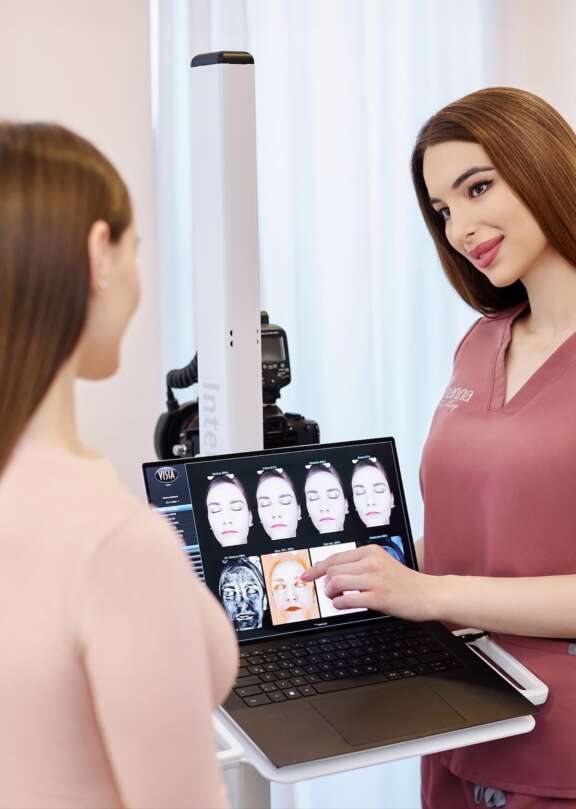
People who come to us are rarely looking for a device. Usually the question is about energy, about sleep, about capacity, and the answer to that does not begin with a machine. Before every visit we take ten minutes, listen, and shape the session around what we hear. Where you do not yet know whether this training is right, the Inanna Consult® is the quiet first step.
Every session is led by our Meisterinnen des Hauses, the masters of the house. With this practice that means, above all, that someone is in the room, reading the values alongside you and acting before a number demands it. A device left to run alone is not a practice but an apparatus.
This work reaches back almost a hundred years. In 1934 the physiologist Nikolai Sirotinin began asking whether a few days in thin air raise tolerance to altitude later. He led nine research expeditions to Mount Elbrus. Through the 1930s Soviet aviation medicine used low-pressure chambers and oxygen-poor gas mixtures to prepare pilots for open cockpits at five to six thousand meters. The same work later passed into space medicine. For some sixty years that research stayed cut off from the West.
What happens inside the cell was only understood much later. In 2019 the Nobel Prize in Physiology or Medicine went to William Kaelin, Peter Ratcliffe and Gregg Semenza, for the discovery of how cells sense oxygen and adapt to it. The prize was for that basic research and not for this application. We name it, and we say what it was not awarded for.
The Mitovit® Hypoxic Training System is built by COMMIT GmbH in Salzgitter, at Dieselstraße 7. The company has traded since 2007 and is entered at the Braunschweig local court under HRB 200804. That provenance is checkable, which is why we name the device and not only the effect.
Technically the device carries an integrated oxygen concentrator instead of pressurized cylinders. Alongside it, two cross-compared pulse oximeters with automatic cut-over, a safety valve to room air on power failure, re-humidified breathing air, and a continuous heart-rate-variability display. The mechanism described in the literature is hormetic: a brief, controlled, sub-threshold stress the cell adapts to, discussed through cellular oxygen sensing and mitochondrial function. Part of that work is animal and in vitro. We describe that position as it stands, and no better.
The room around the device is chosen as well, not simply furnished. The bed comes from Gharieni: Sammy Gharieni arrived in Duisburg on a scholarship in 1981 and qualified as an electrical engineer, and his company still builds these beds in Germany. The linen comes from RKF and is cut, sewn and embroidered at Luxeuil-les-Bains. The cloth itself is woven elsewhere, and we say so.
The oils of Inanna Aromatherapy® come from Original Swiss Aromatics, the company Dr. Kurt Schnaubelt founded in California in 1983. He is a chemist with a doctorate from the Technical University of Munich. Sixty percent is fine lavender, gathered wild in Haute-Provence above eight hundred meters and often over a thousand, cut by hand with a sickle. Fine lavender yields little: lavandin gives nearly three times as much oil.
Bowls of fused quartz like this one are a late twentieth century American invention. They come from the crucible technology of semiconductor manufacture, where quartz is melted to grow silicon. Each carries a serial number, a stated note and a stated frequency.
Inanna Wellness was named Best Day Spa Germany by the World Spa Awards in 2024 and 2025. It is the only CIDESCO-certified house in Berlin, and was portrayed in Vogue Italia in 2025.
We draw the boundary of this offering clearly. IHHT here is not a treatment for any illness and is not offered for one. Anyone coming because of a diagnosis belongs with a physician, and we would rather say so beforehand than afterward.
Mitovit® IHHT is a practice of wellbeing and does not replace medical advice. Questions about it belong in the Inanna Consult®, and for everything else you can reach us through contact.
Treatments